
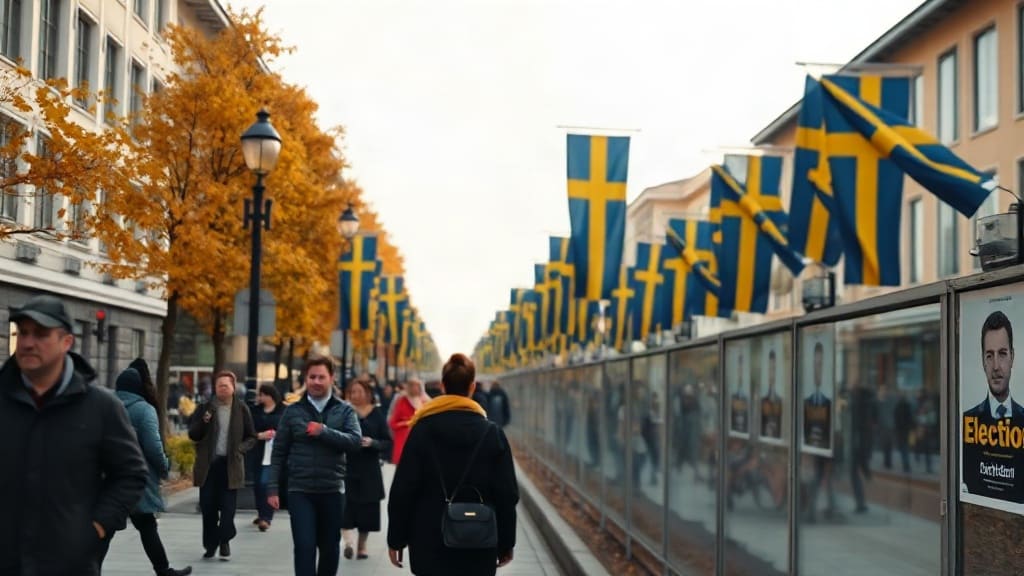
The Swedish election is on a knife-edge, and the business world is holding its breath. With the two main blocs separated by a fraction of a percentage point, the Nordic region's largest economy could be heading for weeks of political limbo. For companies and investors, that means one thing: uncertainty. But within that uncertainty lie both risks and opportunities, and those who understand the shifting landscape will be best positioned to navigate it.
Why This Election Is Different
Sweden has long been seen as a bastion of stability, with a generous welfare state and a consensus-driven political culture. But this election has shattered that image. The traditional left-right divide has been scrambled by the rise of the Sweden Democrats, a party with roots in the far right that has moved toward the mainstream. Their growing influence has forced other parties to reconsider long-held taboos, making coalition arithmetic far more complicated than in the past.
The economy adds another layer of tension. Inflation, energy prices, and a cooling housing market have put pocketbook issues at the top of voters' minds. Meanwhile, Sweden's NATO application has brought foreign policy into the campaign in a way rarely seen before. The result is an electorate more fragmented and anxious than at any point in recent memory.
The Blocs: A Fragmented Landscape
On one side stands the centre-left, led by the Social Democrats under Magdalena Andersson. They have governed with the support of the Left Party, the Centre Party, and the Greens, a coalition held together by a shared desire to keep the Sweden Democrats out of power. On the other side is the right-wing bloc, anchored by the Moderate Party, the Christian Democrats, and the Liberals, but reliant on the Sweden Democrats for a majority.
The problem is that neither bloc has a clear path to a stable government. The Social Democrats are polling at historic highs, but their allies are struggling. The Centre Party has refused to cooperate with the Sweden Democrats, while the Left Party has demanded more influence. On the right, the Moderates have shifted toward the Sweden Democrats on crime and immigration, but the Liberals remain deeply uncomfortable with such an alliance. The result is a political Rubik's Cube that could take weeks, or even months, to solve.
What Business Leaders Are Watching
For the business community, the election's outcome will shape the operating environment for years to come. Three areas stand out.
Energy and Climate Policy
Sweden's energy mix is already largely fossil-free, thanks to hydropower and nuclear. But the nuclear phase-out has been a hot-button issue, with the right pushing for new reactors and the left favouring renewables. A right-wing government could accelerate nuclear investment, while a left-wing one might prioritise wind and solar. For energy-intensive industries like steel and mining, the choice matters enormously. The outcome will also influence Sweden's ability to meet its ambitious climate targets, which in turn affects access to EU funding and green investment.
Taxation and Labour Market
The Social Democrats have promised to raise taxes on high earners and capital, while the right has pledged cuts. For multinational companies, the difference could be substantial. Similarly, labour market regulation is a key battleground. The left wants to strengthen collective bargaining and worker protections, while the right aims to increase flexibility. A shift in either direction could alter the cost of doing business in Sweden, particularly for sectors reliant on skilled labour.
Security and Trade
Sweden's NATO bid has broad support, but the election could influence how quickly the country completes its accession. A government that includes the Sweden Democrats might face friction with Turkey, which has already raised objections. Any delay could prolong uncertainty for defence contractors and companies with exposure to the Baltic Sea region. Trade policy is also at stake: the left has been more sceptical of free trade agreements, while the right is generally more open. For exporters, that could mean the difference between new market access and protectionist barriers.
The Road Ahead: Negotiations and Uncertainty
Once the votes are counted, the real drama begins. Forming a government in Sweden's fragmented parliament is a notoriously slow process. In 2018, it took 134 days to reach a deal. This time could be even longer, given the deep ideological divides and personal animosities between party leaders.
For businesses, this period of limbo is a double-edged sword. On one hand, it delays major policy decisions, creating a holding pattern for investment. On the other, it provides a window to engage with policymakers and shape the agenda. Savvy companies will use this time to build relationships across the political spectrum, ensuring that their concerns are heard regardless of who ends up in power.
The election's outcome will also have ripple effects beyond Sweden's borders. As the largest economy in the Nordic region, Sweden's policy direction influences the entire Baltic Sea area. A shift to the right could embolden conservative forces in Finland and Denmark, while a left-wing victory might reinforce the region's social democratic tradition. For international investors, the signal matters as much as the substance.
Key Sectors to Watch
Certain industries are particularly exposed to the election's outcome.
- Real estate and construction: The housing market has cooled sharply, and both blocs have proposed measures to boost supply. A government that eases planning regulations could revive construction, while one that focuses on rent controls could deter investment.
- Technology and innovation: Sweden has a thriving startup scene, but access to talent is a constant concern. Immigration policy will be a key differentiator, with the right favouring stricter rules and the left more open to skilled workers.
- Financial services: Banking regulation, particularly around mortgage lending and capital requirements, could shift depending on the government. A right-wing coalition might push for deregulation, while the left could tighten oversight.
What to Expect in the Coming Weeks
As the results trickle in, expect volatility in Swedish markets. The krona has already been sensitive to political news, and a prolonged period of uncertainty could weigh on investor confidence. However, Sweden's underlying economic fundamentals remain strong: low public debt, a competitive export sector, and a highly educated workforce. The challenge is political, not economic.
Business leaders should prepare for multiple scenarios. The most likely outcome is a minority government, either led by the Social Democrats or the Moderates, with support from smaller parties. But a grand coalition cannot be ruled out, nor can a snap election if negotiations collapse. In any case, the next few weeks will be critical for shaping Sweden's trajectory.
Frequently Asked Questions
How long will it take to form a government after the Swedish election?
It could take weeks or even months. In 2018, it took 134 days to form a government. Given the current fragmentation, a similar timeline is possible, though a quicker deal is not out of the question if one bloc secures a clear majority.
What does the election mean for foreign investors in Sweden?
Foreign investors should brace for uncertainty in the short term, particularly around taxation, energy policy, and labour regulations. However, Sweden's long-term attractiveness remains intact, and the election is unlikely to fundamentally alter the country's business-friendly environment.
How will the election affect Sweden's NATO membership?
Sweden's NATO application has broad cross-party support, but the inclusion of the Sweden Democrats in a government could complicate relations with Turkey, which has raised objections. This might delay the final ratification process, though most analysts expect Sweden to eventually join.
Will the election lead to major changes in Sweden's climate policy?
Yes, the direction of climate policy is a key dividing line. A right-wing government is likely to reverse the nuclear phase-out and may slow some renewable energy initiatives, while a left-wing government would accelerate the transition away from fossil fuels. Businesses in energy-intensive sectors should monitor this closely.
What are the biggest risks for businesses during the transition period?
The main risk is policy paralysis: with no clear government, major decisions on infrastructure, taxation, and regulation may be delayed. This can create a wait-and-see attitude among investors. Companies can mitigate this by diversifying their engagements and preparing for multiple policy scenarios.