
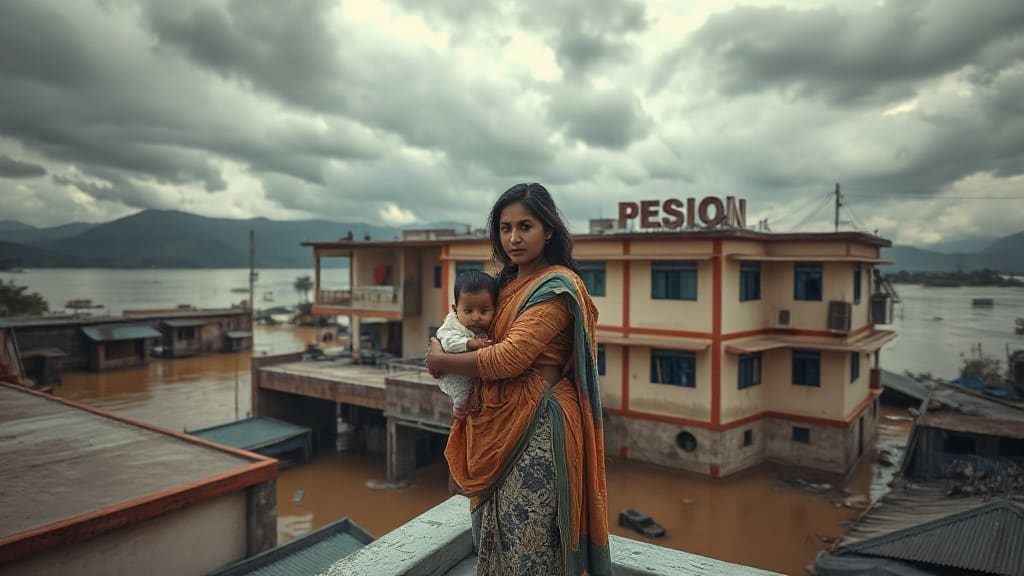
The water came without warning. In the Himalayan border region between Nepal and Tibet, rivers that had run clear for generations turned into walls of mud and debris in a matter of hours. For the people of Trishuli and surrounding towns, the August flash floods were not just a natural disaster; they were a rupture in the rhythm of daily life. Among those caught in the chaos were young mothers, some pregnant, some with newborns, who suddenly found themselves fighting for two lives instead of one.
Pooja Pariyal was one of them. When the floodwaters surged through her town, she grabbed her three-month-old daughter, Ridhika, and fled to the roof of Trishuli hospital. For three days, they waited there. Below them, the town had been churned into a sea of mud. There was no food, no working toilet, and no one to help with the baby. "Those three days were living hell," she recalls. "I had nothing to clean my baby's soiled clothes. I was so hungry that my breast milk dried up, and my poor little one cried and cried."
Pooja's story is not unique. Kalpana Nepali was seven months pregnant when the floods hit. She, too, ended up in a temporary shelter, uncertain about the future. "I don't know if the doctor who was helping me survived," she says. "I don't know if my baby will be okay." For these women, the disaster is far from over. They are now living precariously in makeshift camps, grappling with trauma, loss, and the daunting task of rebuilding their lives.
What Happened in Nepal's Flash Floods?
In August, a series of catastrophic flash floods swept through the Himalayan border region of Nepal and Tibet. The exact trigger is still being studied, but scientists point to a combination of intense monsoon rainfall, glacial melt, and unstable terrain. The region is prone to glacial lake outburst floods (GLOFs), which occur when a glacial lake dam fails and releases a massive volume of water downstream. Climate change is making these events more frequent and more severe, as rising temperatures melt glaciers and create larger, more unstable lakes.
The floods destroyed homes, roads, and bridges. Entire villages were cut off. Hospitals, including Trishuli hospital, became islands of refuge. The death toll is still being tallied, but the human impact is immense. Thousands have been displaced, and many are still missing. For pregnant women and new mothers, the challenges are compounded. They face not only the immediate dangers of the flood but also the long-term health risks of displacement, malnutrition, and lack of medical care.
The Science Behind the Disaster
To understand why these floods were so devastating, it helps to look at the unique geography of the region. The Himalayas are young, steep mountains, and the rivers that flow from them are powerful. When heavy monsoon rains fall on already saturated ground, the water has nowhere to go but down. In August, the monsoon was particularly intense. According to meteorological data, some areas received more than 200 millimeters of rain in a single day. That is equivalent to a month's worth of rain in some regions.
But rain alone does not explain the flash floods. The region also experienced a series of glacial lake outbursts. These lakes form at the foot of retreating glaciers. As the glaciers melt, the lakes grow. Eventually, the moraine dam that holds the lake back can collapse, releasing a torrent of water, ice, and rock. The flood can travel for miles, picking up debris and growing in volume. In August, at least one such outburst is believed to have occurred in Tibet, sending water surging into Nepal.
"The combination of heavy rain and glacial melt is a recipe for disaster," says Dr. Anil Pokhrel, a hydrologist at the International Centre for Integrated Mountain Development (ICIMOD). "We are seeing more of these events, and they are becoming harder to predict. The window for warning is very short."
The Human Cost: Mothers on the Frontline
In any disaster, women and children are often the most vulnerable. In Nepal, cultural norms mean that women are often responsible for caring for children and the elderly, and they may have less access to information and resources. When a flood hits, they may be the last to leave and the first to suffer. Pooja's experience on the hospital roof illustrates this. She was trapped with a baby, unable to move to safety, and without basic supplies. Her story is a stark reminder that disaster response must include the specific needs of women and children.
Kalpana, who was seven months pregnant, faced a different set of challenges. She had been receiving prenatal care at a local clinic, but the flood destroyed the clinic and scattered the medical staff. "I don't know if the doctor survived," she says. "I don't know if I will be able to see a doctor again before my baby is born." Her words reflect the uncertainty that many women face. In the aftermath of a disaster, access to maternal health care is often disrupted. Women may go into labor without a skilled birth attendant, increasing the risk of complications and death.
The Psychological Toll
Beyond the physical dangers, the psychological impact of the floods is profound. Pooja describes the three days on the roof as "living hell." She was constantly worried about her baby's health and safety. She had no way to clean her baby's clothes or feed herself properly. The stress of the situation affected her milk supply, which in turn made her baby cry more. It was a vicious cycle. Now, even though she is in a temporary shelter, she still has nightmares. "I can't sleep," she says. "Every time I close my eyes, I see the water rising."
Mental health services are scarce in Nepal, especially in rural areas. In the aftermath of a disaster, the need for psychological support is great, but the resources are limited. Organizations like the Nepal Red Cross Society and various NGOs are providing counseling, but they are stretched thin. For mothers like Pooja and Kalpana, the emotional scars may take years to heal.
What Comes Next?
The immediate priority is to provide shelter, food, and medical care to those affected. But the longer-term challenges are daunting. The floods have destroyed infrastructure, including roads, bridges, and health facilities. Rebuilding will take time and money. Moreover, the risk of future floods remains high. Climate change is expected to increase the frequency and intensity of extreme weather events in the Himalayas. Without investment in early warning systems, disaster preparedness, and climate adaptation, the region will continue to suffer.
For the mothers, the future is uncertain. They worry about their children's health, their own health, and the ability to provide for their families. Many have lost their homes and livelihoods. Some have lost family members. The road to recovery will be long, and they will need support every step of the way.
Frequently Asked Questions
What caused the flash floods in Nepal in August?
The flash floods were likely caused by a combination of intense monsoon rainfall and glacial lake outburst floods (GLOFs). Climate change is increasing the risk of such events in the Himalayas.
How are pregnant women and new mothers affected by the floods?
They face increased health risks, including lack of access to prenatal and postnatal care, malnutrition, and psychological trauma. Many are displaced and living in temporary shelters without adequate facilities.
What is being done to help the victims?
Humanitarian organizations are providing emergency shelter, food, and medical care. However, the needs are immense, and long-term recovery will require sustained support.
What can be done to prevent future disasters?
Investing in early warning systems, climate adaptation, and disaster preparedness is crucial. Reducing greenhouse gas emissions is also essential to mitigate the root cause of climate change.