
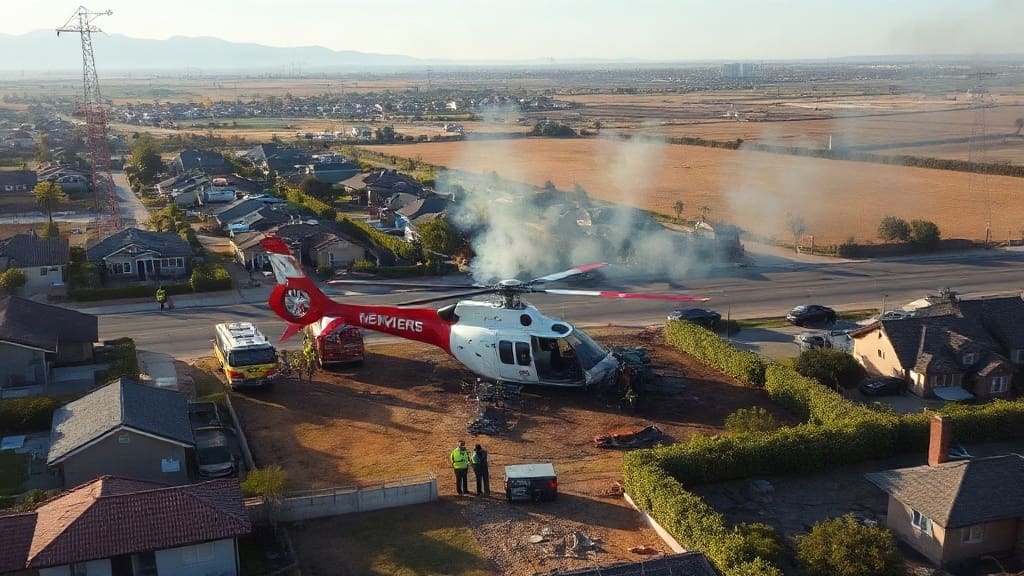
In a heartbreaking turn of events that has shaken both the journalism community and the residents of Chatsworth, a news helicopter operated by NBC Los Angeles crashed on a clear afternoon, killing all three people on board. The incident occurred near the site of another recent tragedy, a Metro bus crash that claimed multiple lives, adding a somber layer to an already grief-stricken neighborhood. As investigators work to piece together what went wrong, the crash raises urgent questions about helicopter safety, the pressures of live news coverage, and the toll these accidents take on those who report the news from above.
The Crash: A Sudden and Devastating Loss
Witnesses described hearing a loud, unnatural sound before the helicopter plummeted to the ground in a field near the intersection of Plummer Street and Canoga Avenue, an area known for its mix of residential streets and open spaces. The aircraft, a Eurocopter AS350 AStar, had been covering a routine story when it went down. Emergency responders arrived within minutes, but the impact was catastrophic, and there were no survivors. The victims were later identified as the pilot and two crew members, all veterans of aerial journalism whose names have not yet been released pending family notification.
The crash site is less than a mile from where a Metro bus collided with a car just weeks earlier, a coincidence that has left many in Chatsworth feeling as though tragedy has become an unwelcome fixture in their community. Local resident Maria Gonzalez, who saw the helicopter go down, said she initially thought it was a small plane. "I've never seen anything like it," she told reporters. "It just fell out of the sky. There was smoke, then silence. It's terrifying to think this happened right where we live."
NBC Los Angeles Responds with Grief and Gratitude
NBC Los Angeles, the flagship station of NBCUniversal's West Coast operations, released a statement expressing profound sorrow over the loss of its colleagues. "Our hearts are broken," the statement read. "These were dedicated professionals who loved bringing the news to our viewers, and they died doing what they believed in. We are working with authorities to understand what happened and will do everything we can to support their families." The station suspended all aerial operations indefinitely, a move that underscores the gravity of the incident and the need for a thorough review of safety protocols.
Colleagues at the station remembered the victims as passionate storytellers who often went above and beyond to capture footage that mattered. One producer, speaking on condition of anonymity, described the pilot as "a true professional with thousands of hours in the air" and the crew as "the kind of people you wanted on your team on a breaking news day." The loss has sent ripples through the tight-knit world of news helicopter operations, where crews often work in close quarters and form deep bonds under the pressure of live deadlines.
Investigating the Cause: A Complex Puzzle
The National Transportation Safety Board (NTSB) and the Federal Aviation Administration (FAA) have dispatched teams to the crash site to begin what will likely be a months-long investigation. Early reports suggest the helicopter may have experienced a mechanical failure, but officials have cautioned against drawing conclusions until the wreckage is fully examined. Weather conditions at the time were clear, with light winds and excellent visibility, making weather-related factors unlikely. The helicopter was relatively new and had passed all recent maintenance checks, according to preliminary statements from the operator.
One area of focus for investigators will be the helicopter's flight path and altitude at the time of the crash. News helicopters often fly at low altitudes to capture detailed footage, which can leave little margin for error in the event of an emergency. Additionally, the proximity to the Metro bus crash site has raised questions about whether the crew was attempting to cover that story when the accident occurred. However, authorities have not confirmed any connection between the two events beyond their geographical coincidence.
The investigation will also examine the pilot's training and experience, the helicopter's maintenance history, and any potential external factors such as bird strikes or drone interference. Drones have become an increasing concern for low-flying aircraft, particularly in urban areas, though there is no evidence at this time that a drone was involved. The NTSB's final report will likely take 12 to 18 months to complete, but a preliminary finding could be released within weeks.
A Community Already in Mourning
For the residents of Chatsworth, this latest tragedy has reopened wounds from the Metro bus crash that occurred just a short distance away. That incident, which involved a bus and a passenger vehicle, resulted in multiple fatalities and injuries, prompting an outpouring of grief and calls for improved road safety measures. Now, with a helicopter crash in the same area, community leaders are calling for a broader conversation about safety across all modes of transportation.
"We are a resilient community, but this is a lot to bear," said Chatsworth Neighborhood Council President John Lee. "Our hearts go out to the families of the helicopter crew, and we stand ready to support them in any way we can. We also want answers. People are asking why this happened and what can be done to prevent it from happening again." A vigil is being planned for the victims, and local churches have offered counseling services to those affected by the recent tragedies.
The proximity of the two crash sites has also led to some speculation on social media about whether the area is somehow cursed or unsafe. However, experts emphasize that the incidents are unrelated and that such coincidences, while tragic, are not statistically unusual in a large metropolitan area. "It's human nature to look for patterns, but there is no evidence to suggest any common cause," said aviation safety analyst Dr. Emily Carter. "What we need is a careful, methodical investigation, not speculation."
The Broader Implications for News Helicopter Safety
The crash has reignited a long-standing debate about the safety of news helicopters, which have been a staple of local television coverage for decades. While accidents are relatively rare, they do occur, and each one prompts a reexamination of industry practices. In 2014, a news helicopter crash in Seattle killed two people, and in 2019, a helicopter carrying a news crew went down in North Carolina, resulting in serious injuries. These incidents have led to calls for stricter regulations, better training, and the use of newer technology such as collision avoidance systems.
Some industry observers have also questioned whether the proliferation of drones and other unmanned aerial vehicles could reduce the need for manned helicopters in news gathering. Drones are cheaper, quieter, and can access areas that helicopters cannot, but they also have limitations in terms of flight time, payload capacity, and regulatory constraints. For now, helicopters remain an essential tool for covering breaking news, traffic, and weather events, but the risks they carry are undeniable.
"Every time we send a crew up, we weigh the story against the risk," said a veteran news director who asked not to be named. "It's a decision we never take lightly. But the public expects live coverage, and our crews are professionals who understand the dangers. This crash is a stark reminder that those dangers are real, even on a seemingly routine day."
The Human Toll: Remembering the Victims
As the investigation continues, the focus is slowly shifting to the lives that were lost. The three individuals aboard the helicopter were more than just employees of a television station; they were parents, spouses, friends, and colleagues who dedicated their careers to informing the public. Their names have not been officially released, but tributes have begun to appear on social media from those who knew them. A former colleague described one of the crew members as "the kind of person who would give you the shirt off his back," while another remembered the pilot as "a consummate professional who loved flying more than anything."
The loss is particularly poignant given the nature of their work. News crews often find themselves in the middle of tragedy, documenting the worst moments of people's lives from a safe distance. To become the subject of that tragedy is a cruel irony that has not been lost on the journalism community. "We tell stories about others every day," said a reporter from a competing station. "Now we are the story, and it hurts more than I can say."
Support services have been made available to employees at NBC Los Angeles, and the station has set up a fund to assist the families of the victims. The broader community has also rallied, with local businesses offering meals and other support to first responders and station staff. It is a small comfort in the face of such overwhelming loss, but it speaks to the resilience of a community that has faced more than its share of sorrow in recent weeks.
What Happens Next: A Long Road Ahead
In the coming days, investigators will continue to sift through the wreckage, looking for clues that might explain what went wrong. The NTSB will likely issue a preliminary report within 30 days, outlining the basic facts of the crash without assigning a probable cause. That determination will come later, after a thorough analysis of the evidence. In the meantime, the families of the victims will begin the painful process of saying goodbye, and the journalism community will reflect on the risks inherent in the pursuit of news.
For the residents of Chatsworth, the crash is yet another reminder of the fragility of life. The fact that it occurred so close to the site of a previous tragedy has left many feeling unsettled, even as officials assure them that the incidents are unrelated. "It's like a dark cloud has settled over our neighborhood," said Gonzalez. "We just want it to lift."
The crash is also likely to prompt a broader conversation about the safety of news helicopter operations, not just in Los Angeles but across the country. Regulators, industry leaders, and journalists will all have a role to play in ensuring that the lessons learned from this tragedy are not forgotten. For now, though, the focus remains on honoring the lives that were lost and supporting those who are left behind.
Frequently Asked Questions
How many people died in the NBC Los Angeles helicopter crash?
Three people died in the crash: the pilot and two crew members. All were employees of NBC Los Angeles or its contracted helicopter operator. Their identities have not been officially released, but the station has confirmed that there were no survivors.
Where exactly did the helicopter crash in Chatsworth?
The crash occurred in a field near the intersection of Plummer Street and Canoga Avenue in Chatsworth, a neighborhood in the San Fernando Valley region of Los Angeles. The site is less than a mile from where a Metro bus crash occurred weeks earlier, though the two incidents are not believed to be related.
What type of helicopter was involved in the crash?
The helicopter was a Eurocopter AS350 AStar, a single-engine aircraft commonly used for news gathering, law enforcement, and utility work. It is known for its reliability and maneuverability, but like any aircraft, it is subject to mechanical failures and other risks.
What caused the helicopter to crash?
The cause of the crash is under investigation by the NTSB and FAA. Early reports suggest a possible mechanical failure, but officials have not confirmed this. Weather conditions were clear, and the pilot was experienced. A full report is expected within 12 to 18 months, with a preliminary finding possibly within weeks.
Has NBC Los Angeles suspended helicopter operations?
Yes, NBC Los Angeles has suspended all aerial operations indefinitely following the crash. The station said the move is out of respect for the victims and to allow for a thorough review of safety protocols. Other stations in the market may also review their procedures in light of the incident.