
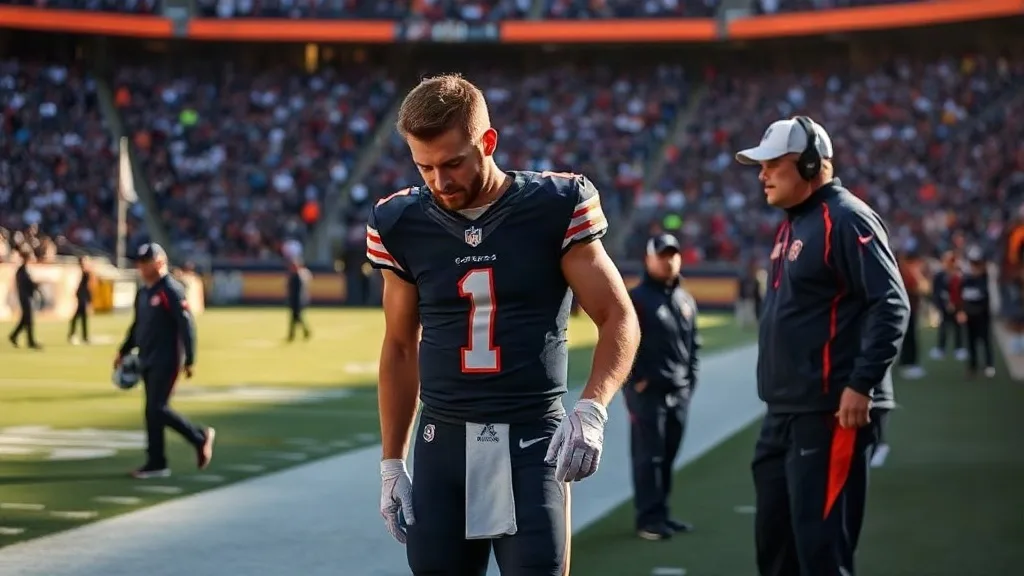
The Chicago Bears may finally have their franchise quarterback back on the practice field, but that doesn't mean Caleb Williams will be under center when the team lines up for its next game. Speaking to reporters on Wednesday, Williams acknowledged that while he has been cleared for full participation in practice, his availability for Sunday's matchup remains up in the air. "I don't know if I'm playing yet," Williams said, adding that the hamstring injury he suffered last month was a serious tear that demanded a cautious approach.
It's a sobering update for a Bears team that has been forced to navigate a critical stretch of the season without its starting quarterback. Williams, the No. 1 overall pick in the 2024 NFL Draft, has been sidelined since Week 2, and his absence has exposed both the promise and the limitations of Chicago's offense. Now, with the rookie signal-caller inching closer to a return, the organization faces a delicate balancing act: rush him back to salvage the season, or prioritize his long-term health at the risk of falling further out of contention.
The Injury: More Than a Tweaked Hamstring
Hamstring injuries are often dismissed as minor setbacks in the NFL, the kind of ailment that costs a player a week or two at most. But Williams was quick to clarify that his situation was different. He described the injury as a serious tear, a classification that suggests a higher-grade strain, possibly involving partial muscle fiber disruption. Such injuries can linger for weeks or even months if not managed properly, and they carry a significant risk of re-injury if a player returns before fully healed.
For a quarterback, the hamstring is a critical component of the kinetic chain. It powers the push-off on deep throws, the scramble out of the pocket, and the subtle weight transfer that generates velocity. Even a minor deficit in hamstring strength or flexibility can alter a quarterback's mechanics, leading to inaccurate passes or compensatory injuries elsewhere. Williams, whose mobility and off-schedule playmaking were hallmarks of his college career at USC, relies heavily on his athleticism to extend plays. A compromised hamstring doesn't just limit his running ability; it can undermine the very foundation of his throwing motion.
The Bears' medical staff has been understandably conservative. After Williams initially suffered the injury in Week 2, he was limited in practice and eventually held out of games. His return to full participation on Wednesday marks a significant milestone, but it does not guarantee he will suit up on Sunday. The team will likely evaluate his response to practice throughout the week, monitoring for soreness, swelling, or any drop in explosiveness. Only then will they make a final determination.
What This Means for the Bears' Offense
Without Williams, the Bears have turned to veteran backup Tyson Bagent, who has provided a steady but unspectacular presence under center. Bagent has managed games effectively, avoiding turnovers and keeping Chicago competitive, but he lacks Williams' arm talent and playmaking upside. The offense has become more conservative, leaning on the run game and short passing concepts. While that approach has kept the team in games, it has also limited their ceiling.
Williams' return would immediately inject life into a passing attack that has struggled to stretch the field vertically. His ability to escape pressure and create off-platform throws would give the Bears a dimension they simply don't have with Bagent. However, inserting a quarterback back into the lineup after a multi-week absence is rarely seamless. Timing, chemistry, and conditioning all take time to recalibrate. Williams has been participating in meetings and film sessions, but live reps against a first-team defense are irreplaceable.
There's also the matter of the offensive line. Chicago's front five has been inconsistent in pass protection, allowing pressure at a rate that would test any quarterback. If Williams returns before he's fully confident in his hamstring, he may be more prone to sacks or hurried throws. The coaching staff must weigh the potential boost to the offense against the risk of exposing their franchise quarterback to further injury behind a shaky line.
The Bigger Picture: A Rookie's Development
For Williams, this injury is more than just a physical setback. It's a disruption to his development as a rookie quarterback. The transition from college to the NFL is already steep, requiring rapid mastery of complex defenses, faster processing, and refined footwork. Missing games and practice reps slows that growth. Every week on the sideline is a week without live experience, without the trial-and-error that shapes a young passer.
Yet there's a silver lining. Williams has been able to observe from a different vantage point, studying defenses and learning from Bagent's decision-making. He's also had extra time to work on his mental preparation, which can pay dividends down the line. Still, there's no substitute for game reps, and the Bears must be careful not to let his rookie season slip away entirely.
The organization has emphasized patience, a stance that aligns with the long-term vision of building around Williams. General manager Ryan Poles and head coach Matt Eberflus have repeatedly stated that they will not jeopardize Williams' future for short-term gains. That philosophy will be tested in the coming days as they decide whether to play him this week or hold him out until after the bye.
What to Watch in the Coming Days
All eyes will be on the practice reports. If Williams strings together multiple full practices without setbacks, the likelihood of him starting increases. The team may also opt to list him as questionable on the injury report, a designation that keeps his status uncertain until game time. Williams himself has said he won't play unless he feels fully capable. "I'm not going to go out there at 80 percent," he explained. "That's not fair to my teammates or myself."
From a strategic standpoint, the Bears might consider giving Williams an extra week of rest, especially if the matchup is unfavorable. But with the season slipping away, the pressure to win now could influence the decision. It's a classic dilemma: protect the future or chase the present.
For fantasy football managers and Bears fans alike, the uncertainty is frustrating. But it's also a reminder that hamstring injuries are notoriously unpredictable. Even when a player returns, the risk of aggravation remains high for several weeks. Williams and the Bears will need to communicate openly and make a decision that balances competitive urgency with medical prudence.
Frequently Asked Questions
What exactly did Caleb Williams say about his hamstring injury?
Williams described the injury as a "serious tear" and stated that he doesn't know yet if he'll play in the upcoming game. He emphasized that he won't return until he's fully healthy.
When did Caleb Williams suffer the hamstring injury?
The injury occurred in Week 2 of the 2024 NFL season. He has been sidelined since then, though he returned to full practice participation recently.
Who is the Bears' backup quarterback?
Tyson Bagent, a second-year player out of Shepherd University, has been filling in for Williams. He has started multiple games in Williams' absence.
How long does a serious hamstring tear take to heal?
Recovery time varies depending on the severity, but a serious tear can take four to eight weeks or more. Proper rehabilitation and gradual return to activity are crucial to avoid re-injury.
What are the risks of returning too soon from a hamstring tear?
Returning prematurely can lead to re-injury, chronic pain, and compensatory injuries. It can also impair performance, as the hamstring is vital for throwing mechanics and mobility.